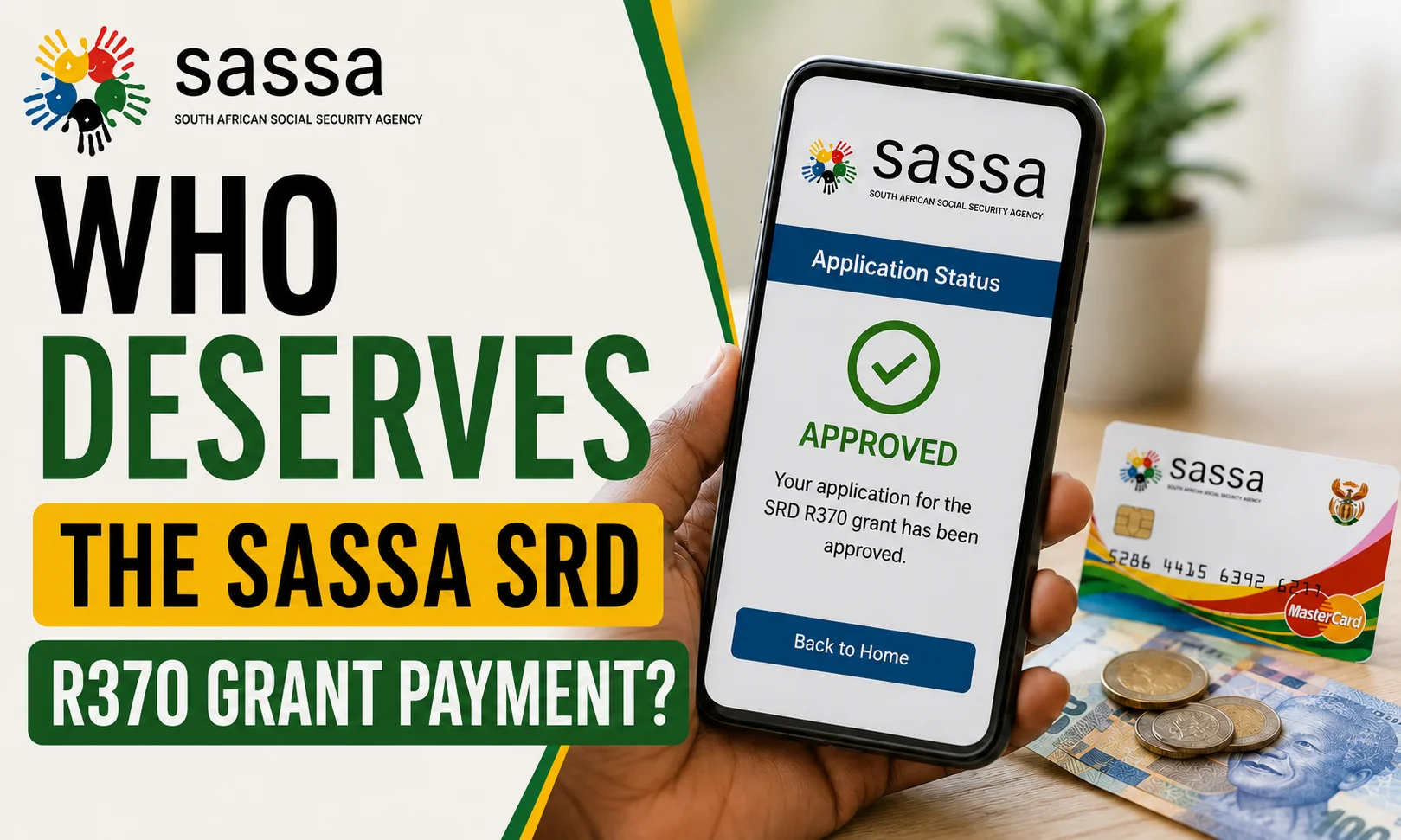
Who Deserves the SASSA SRD R370 Grant Payment?

The SASSA SRD R370 grant payment is a monthly social assistance program administered by the South African Social Security Agency (SASSA) to support unemployed individuals without a stable income. The South African Social Security Agency (SASSA) applies strict eligibility rules to ensure fair distribution of public funds among qualifying citizens and residents.
The program targets individuals who face financial hardship due to unemployment or a lack of alternative social support. Eligibility decisions depend on income verification, identity validation, and cross-checks with other government systems.
This article explains who deserves the SASSA SRD R370 grant payment, including requirements, disqualification factors, and assessment methods used by SASSA. The following sections break down each eligibility dimension in structured detail.
Core eligibility criteria for SASSA SRD R370 grant payment
Citizenship and residency status requirements
The South African Social Security Agency (SASSA) restricts the SRD R370 grant payment to individuals who meet specific citizenship or residency conditions. Applicants must hold valid South African citizenship, permanent residency, or approved asylum seeker or special permit status. SASSA uses national identity systems to verify legal status.
Key requirements include:
- Valid South African identity document or approved alternative documentation
- Registered presence in national population records
- Legal residency confirmation for non-citizens with approved status
- Active mobile number linked to identity records
These conditions ensure that SASSA SRD R370 grant payment distribution remains legally compliant and accurately targeted.
Age and demographic qualification rules
The SASSA SRD R370 grant payment applies to adults within working age who do not receive alternative social grants. The program primarily supports individuals who are economically active but unemployed.
Eligibility conditions include:
- Minimum age requirement aligned with the national adulthood 기준
- Exclusion of individuals receiving old-age support grants
- Exclusion of children supported under child-related grants
- Verification of demographic identity through official records
SASSA uses population registry data to confirm demographic eligibility.
Income threshold and financial means test
The SASSA SRD R370 grant payment uses a means test to determine financial need. This test evaluates bank account activity, income inflows, and financial support sources. The goal is to identify individuals with no stable income.
Income assessment includes:
- Bank transaction review over defined evaluation periods
- Detection of regular salary deposits
- Identification of alternative financial support channels
- Cross-referencing with employment databases
Applicants with income above the defined threshold set by SASSA do not qualify for the SASSA SRD R370 grant payment.
Employment status and unemployment verification
Unemployment condition requirements
The SASSA SRD R370 grant payment targets individuals without formal employment. Employment verification plays a central role in approval decisions.
SASSA evaluates:
- Registered employment contracts in national systems
- Employer declared income records
- Tax-related employment activity
- Formal payroll system entries
Individuals with active employment records do not qualify for the SASSA SRD R370 grant payment.
Informal income evaluation
SASSA also evaluates informal income sources that may not appear in formal employment systems. This includes irregular financial inflows that indicate economic stability.
Evaluation factors include:
- Frequent cash deposits into bank accounts
- Digital payment platform income activity
- Consistent third-party financial support
- Business-related transaction patterns
Applicants with consistent informal income patterns may be excluded from the SASSA SRD R370 grant payment.
Dependency on other social grants
Exclusion based on existing government support
The SASSA SRD R370 grant payment does not apply to individuals who already receive other forms of government financial assistance. This prevents duplication of benefits across social programs.
Excluded categories include:
- Old age pension beneficiaries
- Disability grant recipients
- Child support grant beneficiaries linked to primary caregivers
- Other state-funded income support programs
SASSA cross-checks all applicants against national grant databases to enforce this rule.
Household support evaluation
SASSA also considers indirect support received within households. Individuals living in financially supported households may not qualify.
Assessment includes:
- Household income aggregation analysis
- Identification of primary income earners in the household
- Dependency ratio evaluation
- Shared financial resource detection
This ensures that the SASSA SRD R370 grant payment targets individuals without household-based financial stability.
Identity verification and fraud prevention
Biometric and document validation
The SASSA SRD R370 grant payment system uses identity verification to prevent fraudulent claims. Applicants must match official identity records.
Verification steps include:
- Identity number validation against the national database
- Mobile number ownership confirmation
- Bank account ownership matching identity records
- Biometric verification, where applicable
These steps ensure accurate allocation of funds.
Fraud detection indicators
SASSA applies automated checks to detect suspicious applications.
Common indicators include:
- Multiple applications linked to one identity
- Conflicting banking information
- Duplicate identity submissions
- Inconsistent personal data entries
Applications flagged for fraud risk do not qualify for the SASSA SRD R370 grant payment until resolved.
Application assessment process for SASSA SRD R370 grant payment
Step-by-step evaluation workflow
The SASSA SRD R370 grant payment application follows a structured evaluation process.
- Submission of the application through official SASSA channels
- Identity verification against national registry systems
- Income and financial means testing
- Employment status validation
- Cross-checking with other grant databases
- Final eligibility decision generation
Each step ensures accurate eligibility determination.
Data sources used by SASSA
SASSA relies on multiple government and financial data systems to assess eligibility.
| Data source | Purpose of verification |
|---|---|
| National population registry | Identity confirmation |
| Banking institutions | Income and transaction analysis |
| Employment databases | Job status verification |
| Social grant systems | Duplicate benefit prevention |
| Mobile network records | Contact validation |
These systems work together to ensure accurate SASSA SRD R370 grant payment decisions.
Reasons for approval of SASSA SRD R370 grant payment
Approved eligibility conditions
Applicants receive approval when all eligibility conditions are met. Approval reflects financial need and lack of alternative support.
Approval indicators include:
- No active employment record
- No alternative social grant receipt
- Income below SASSA-defined threshold
- Verified identity and residency status
- Clean fraud screening result
Approved applicants gain access to a monthly SASSA SRD R370 grant payment support.
Beneficiary profiles that qualify
Typical approved applicants include:
- Unemployed individuals actively seeking work
- Informal workers with unstable income
- Individuals without household financial support
- Adults are excluded from other social assistance programs
These groups represent the primary target population of the SASSA SRD R370 grant payment system.
Reasons for rejection of the SASSA SRD R370 grant payment
Common disqualification factors
SASSA rejects applications when eligibility conditions are not met.
Common rejection reasons include:
- Existing employment income detected
- Receipt of other government grants
- Bank account income above threshold
- Invalid or mismatched identity information
- Duplicate application records
Each rejection follows automated and manual verification checks.
Appeal-related conditions
Applicants may request a review when rejection occurs due to data errors.
Appeal-related issues include:
- Incorrect income detection
- Identity verification mismatches
- Banking data inconsistencies
- Outdated employment records
SASSA re-evaluates corrected data before final decision confirmation.
Social and economic purpose of the SASSA SRD R370 grant payment
Poverty alleviation function
The SASSA SRD R370 grant payment supports individuals facing temporary or structural unemployment. The program reduces immediate financial pressure on households without income sources.
Key social outcomes include:
- Short-term income support for basic needs
- Reduced household food insecurity
- Temporary financial stability during unemployment
- Support for job-seeking activities
Government resource allocation efficiency
The SASSA SRD R370 grant payment system ensures targeted use of public funds. Eligibility screening prevents misuse and duplication of benefits.
Efficiency measures include:
- Automated eligibility screening systems
- Cross-agency data verification
- Continuous beneficiary re-evaluation
- Fraud prevention monitoring
These mechanisms support fair distribution of government resources.
Extended eligibility considerations and real-world assessment
Financial behavior evaluation perspective
Financial institutions used by SASSA provide transaction data that reflects applicant stability. Regular income patterns reduce eligibility probability. Irregular or absent income patterns increase qualification likelihood.
Assessment factors include:
- Monthly deposit frequency
- Average account balance trends
- Third-party payment consistency
- Cash withdrawal patterns
Administrative perspective on eligibility
SASSA administrators evaluate eligibility based on system-generated data reports. Administrative decisions prioritize accuracy and fraud prevention.
Administrative focus areas include:
- Data consistency across systems
- Identity confirmation reliability
- Duplicate record elimination
- Policy compliance enforcement
Applicant perspective on eligibility
Applicants depend on clear communication of eligibility rules. Understanding income thresholds and documentation requirements improves application success probability.
Key applicant considerations include:
- Accurate personal data submission
- Updated banking information
- Consistent identity records
- Awareness of disqualification factors
This alignment reduces delays in SASSA SRD R370 grant payment processing.