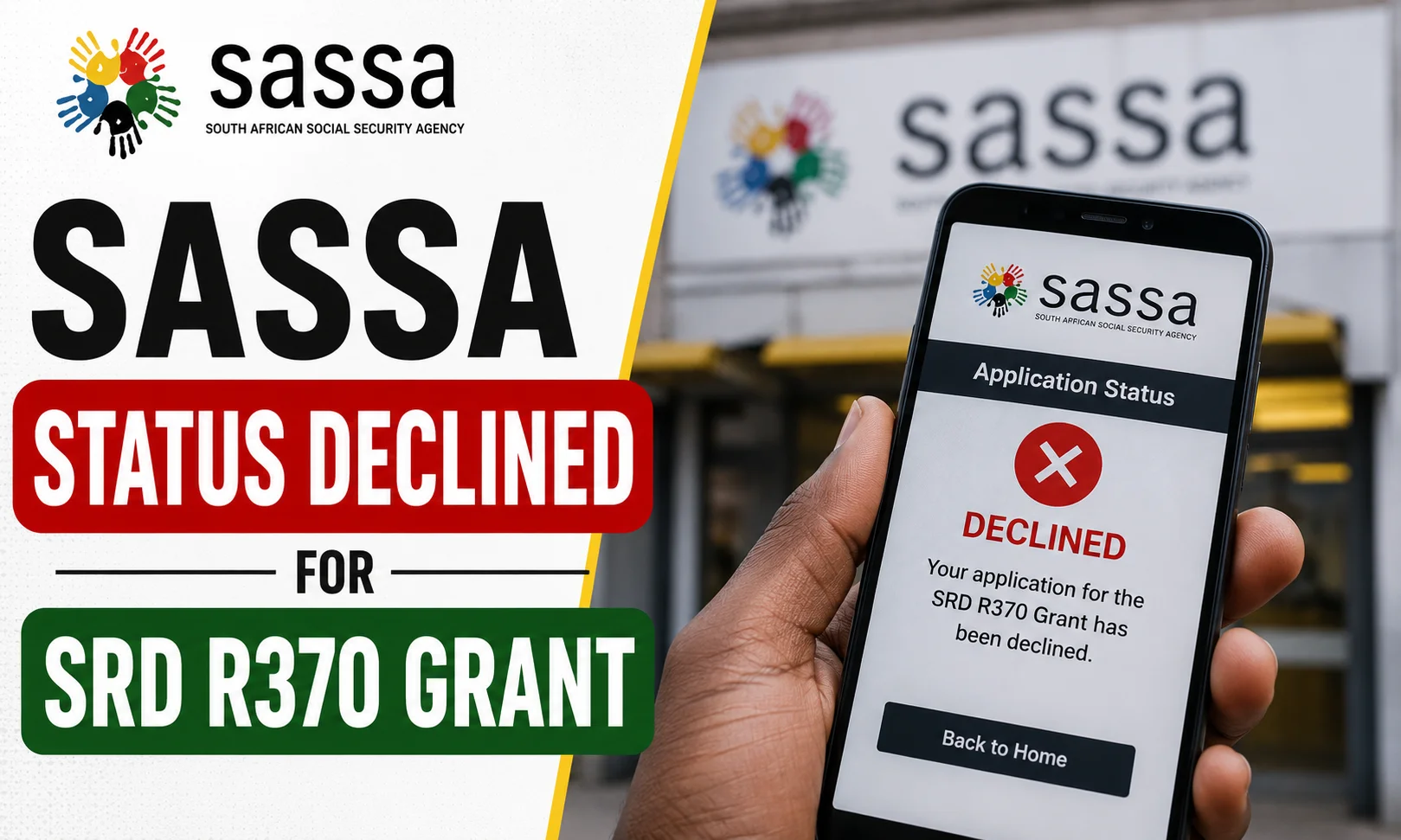
SASSA Status Declined for SRD R370 Grant

A SASSA Status Declined result indicates that the South African Social Security Agency (SASSA) has rejected a Social Relief of Distress (SRD) grant application after eligibility verification. The South African Social Security Agency (SASSA) administers the Social Relief of Distress (SRD) R370 grant in South Africa and processes millions of applications during monthly assessment cycles.
A declined status occurs when verification systems identify income above the required threshold, identity verification failure, or records showing alternative government support such as unemployment insurance or other grants.
Applicants receive this outcome during routine SASSA evaluation cycles that assess financial eligibility and identity consistency. Understanding the reasons behind a declined status allows applicants to identify eligibility gaps and review application data for accuracy and compliance with SASSA requirements.
Why SASSA SRD Grant Application is Declined, Despite of I am All Eligible?
South African Social Security Agency SRD R370 grant application status declines when verification systems detect eligibility conflicts in applicant records. The South African Social Security Agency applies automated checks to confirm income level, identity validity, and alternative government support.
Applicants receive declined outcomes when UIF records, NSFAS records, or bank income data exceed SASSA threshold requirements. Identity mismatches and incomplete banking verification also trigger rejection during SASSA assessment cycles. For example, duplicate applications or incorrect ID linkage can cause automated denial even when the applicant qualifies otherwise. Data inconsistencies between banking systems and SASSA databases create verification errors that result in declined status decisions.
Applicants must review submitted details and correct errors to align with SASSA eligibility rules for reconsideration. Status corrections depend on updated verification outcomes processed in the next SASSA review cycle. We recommend accurate record submission to reduce future decline risks across the SASSA SRD assessments verification alignment process.
When Does SASSA Decline a SRD Application?
Below are the reasons that can decline a SASSA SRD application.
Income exceeds SASSA SRD threshold
South African Social Security Agency (SASSA) declines SRD R370 applications when the monthly income exceeds the approved limit. SASSA uses bank verification systems to scan incoming deposits across all registered accounts. Any income above the defined threshold triggers automatic rejection. This includes salary payments, informal business deposits, or third-party transfers that indicate financial support.
UIF registration detected
SASSA rejects SRD applications when applicants appear in the Unemployment Insurance Fund (UIF) databases. UIF registration indicates access to another government support system. SASSA cross-checks UIF records during monthly eligibility assessments. Active UIF claims or recent UIF payments lead to application decline.
NSFAS support active
SASSA declines SRD applications when applicants receive National Student Financial Aid Scheme (NSFAS) funding. NSFAS provides education-related financial assistance. SASSA systems flag NSFAS beneficiaries because dual support violates SRD eligibility rules. This match occurs through government database integration.
Identity verification failure
SASSA rejects applications when South African ID details do not match Department of Home Affairs records. Incorrect ID numbers, invalid personal data, or inactive identity records trigger failure. SASSA requires exact identity alignment before approval.
Banking details mismatch
SASSA declines applications when bank account details do not match applicant’s identity records. Incorrect account holder names, closed accounts, or unsupported banks create verification failure. SASSA performs monthly bank validation checks to confirm payment readiness.
Duplicate application detected
SASSA rejects SRD applications when multiple applications exist under the same identity number. Duplicate submissions create system conflicts during verification cycles. SASSA retains only one active application per applicant per month.
Government employment record found
SASSA declines applications when applicants appear as active government employees. Payroll systems linked with state institutions flag employment income. SRD support targets unemployed individuals without formal government salaries.
Fraud or risk flag identification
SASSA uses automated risk detection systems to identify suspicious activity. Repeated mismatched data entries or inconsistent personal information trigger fraud alerts. Flagged applications remain declined until verification is cleared.
Age eligibility not met
SASSA SRD grant requires applicants to fall within the approved age range of 18 to 59 years. Applications outside this range receive automatic rejection. Age validation is confirmed through national identity records.
Existing social grant beneficiary status
SASSA declines SRD applications when applicants already receive other social grants. This includes disability grants, child support grants, or old-age pensions. SASSA prevents duplicate government support across multiple programs.
Alternative income source detected
SASSA rejects applications when bank screening identifies consistent external income sources. Regular deposits indicate financial stability beyond SRD requirements. SASSA evaluates transaction history during eligibility checks.
How to Fix SASSA Status Declined?
Follow these my tested solutions:
Update bank account details in the SASSA SRD system
SASSA SRD R370 applicants must ensure bank account details match their registered identity. The South African Social Security Agency rejects applications when the account holder’s name differs from ID records. Applicants should submit correct banking information through the SASSA SRD portal. Accurate bank data allows payment verification during monthly assessment cycles.
Correct identity information with the Department of Home Affairs
SASSA SRD status declines when identity records do not match Department of Home Affairs data. Applicants must verify ID number, name spelling, and citizenship status. Updated identity records improve verification alignment between SASSA systems and national databases.
Remove UIF registration conflicts
SASSA SRD applications decline when Unemployment Insurance Fund records show active claims. Applicants must ensure UIF benefits are inactive or closed. UIF system updates must reflect termination of benefits before SASSA reassessment.
Resolve NSFAS beneficiary linkage
SASSA rejects applications when National Student Financial Aid Scheme support is active. Applicants must confirm NSFAS status accuracy in government databases. Correction requests must be submitted if NSFAS records are outdated or incorrect.
Eliminate duplicate SRD applications
SASSA systems decline applications when multiple entries exist for one identity number. Applicants must keep only one active SRD application. Duplicate entries must be removed through the official SASSA portal.
Verify income records with bank statements
SASSA SRD eligibility fails when bank transactions show income above threshold limits. Applicants must review bank activity for consistent deposits. Irregular income records should be corrected before reapplication.
Appeal SASSA SRD decline decision
SASSA provides an appeal process for declined applications. Applicants must submit an appeal through the SASSA SRD reconsideration system. Each appeal undergoes re-evaluation using updated government database checks.
Recheck age eligibility compliance
SASSA SRD grants apply to individuals aged 18 to 59 years. Applicants outside this range receive automatic rejection. Identity records must confirm the correct age before reapplication.
Correct personal data mismatches
SASSA declines applications when personal details differ across government systems. Applicants must ensure consistent name, surname, and ID data. Accurate records improve approval probability in the next review cycle.